
The new value drivers in global Supply Chain Management
SUPPLY CHAIN MANAGEMENT: BETWEEN GEOPOLITICS AND NEW OPERATIONAL RISKS
Geopolitical tensions, protectionism, market volatility and disruptions to shipping routes have shown that it is no longer enough to organise procurement and transport purely with a view to cost containment; managing the supply chain has become a key factor in companies’ competitiveness.
We need to build supply chains capable of withstanding shocks, diversifying suppliers and markets, ensuring production continuity and protecting margins. Logistics thus plays a strategic role, as it affects the ability to meet delivery deadlines, honour commitments to customers and seize new business opportunities.
These issues are the focus of a study carried out in early 2026 by SRM and Contship which analyses the logistics choices of 400 manufacturing companies in Lombardy, Veneto and Emilia-Romagna that are involved in import-export maritime traffic. The study reveals that 43% of companies have already experienced the effects of geopolitical tensions on their logistics, confirming that international risk is now an operational variable that must be factored into industrial and financial decisions.
DIGITALIZATION AND AI: FROM SUPPLY CHAIN VISIBILITY TO THE QUALITY OF DECISIONS
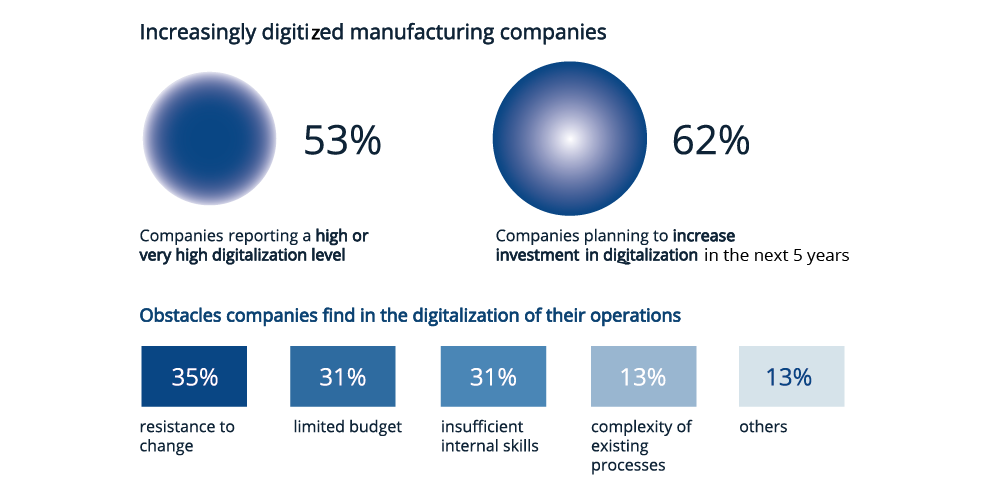
Digitalization is essential for making the supply chain transparent, measurable and manageable. Integrating data on orders, production, warehouses and transport makes it possible to anticipate critical issues, reduce inefficiencies and make decisions more quickly. 53% of the companies in the sample consider themselves to be highly or fully digitized; 62% plan to increase their investment in digital technologies over the next five years; and 28% already allocate more than 5% of their turnover to these technologies. However, significant obstacles remain, such as resistance to change, limited budgets and a lack of in-house expertise.

AI marks the next step: from a supply chain that collects data to a supply chain capable of interpreting it and supporting decisions. Applications range from demand forecasting and the optimisation of stock levels and routes to supplier monitoring and the early identification of risks.
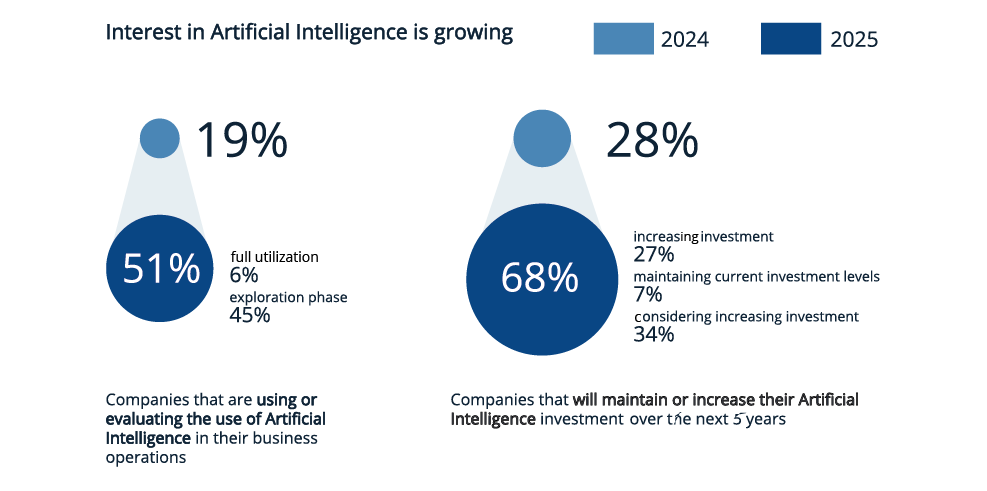
The study highlights a marked acceleration: the percentage of companies surveyed that have already introduced AI or are considering its adoption rose from 19% in 2024 to 51% in 2025. 68% also plan to maintain or strengthen their investment or are considering increasing it. The expected benefits will extend to a wide range of business functions, from production to marketing, and from research and development to supply chain management.
SUPPLY CHAIN RISK INTELLIGENCE: ANTICIPATING RISKS THROUGH DATA
Of particular significance is the use of Supply Chain Risk Intelligence systems, which are being used or trialled by 32% of the companies in the sample, compared with 15% in 2024. These tools enable the cross-referencing of logistics data, market information and geopolitical indicators to anticipate disruptions, delays and procurement issues. In fact, 46% of companies believe that AI will have a positive impact on logistics, particularly in terms of improving performance.
The real challenge is to turn experimentation into measurable results. To generate value, AI must be integrated into processes, fed by reliable data and supported by the right skills. Interoperability, cybersecurity, training and organizational review are therefore essential for technology to translate into greater productivity, resilience and growth.
INTERMODAL TRANSPORT AND THE GREEN SUPPLY CHAIN: SUSTAINABILITY AND EFFICIENCY
The sustainability of supply chains cannot be separated from economic efficiency. Reducing emissions, fuel consumption and unproductive mileage also means containing costs, improving the reliability of supply flows and limiting exposure to energy and regulatory volatility.
From this perspective, intermodality represents an important lever, but it is still under-utilised. On average, between 2019 and 2025, only 11% of the companies surveyed used combined road-rail transport for journeys between their premises and the port. Over the next two years, however, 21% plan to, or are considering, increasing their use of it. To realise its potential, reliable connections, efficient terminals, digital integration between operators, and services that are competitive in terms of both time and cost are needed.
INVESTMENT AND FINANCE FOR THE TRANSFORMATION OF SUPPLY CHAINS
The transformation of supply chains therefore requires comprehensive programmes, encompassing digital platforms, automation, logistics infrastructure, cyber security, energy efficiency and intermodal solutions. For larger companies, the key is not to finance a single technology, but to develop business plans that integrate innovation, sustainability and growth.
In this context, finance can support complex, long-term projects, helping to transform isolated technological or environmental initiatives into coherent, measurable investments that form part of a clear development strategy.
THE COMPETITIVE ADVANTAGE LIES WITH CONNECTED SUPPLY CHAINS
Competitive advantage will increasingly lie with companies capable of building connected, smart and sustainable supply chains, integrating data, technology, infrastructure and expertise to anticipate changes and capitalize on new market opportunities.
Digital innovation, AI and sustainability are not separate paths, but components of a single industrial strategy. The supply chain thus becomes a tangible indicator of a company’s quality: it measures its ability to innovate, make sound decisions and compete in the long term.
SOURCE Survey of Manufacturing Companies: Corridors and Logistical Efficiency of Regions 2026, compiled by SRM and Contship.
F.A.Q.
F.A.Q.