
Sea-rail intermodal transport, a driver of competitiveness
LOGISTIC EFFICIENCY AND INTERMODALITY: A DRIVER OF COMPANIES' COMPETITIVENESS
In international value chains, logistics has a direct impact on companies' competitiveness. Delivery times, transport costs and supply continuity affect the ability to reach markets, meet commercial commitments and seize growth opportunities. Therefore, the efficiency of connections is also a factor of attractiveness for territories and the production system.
Intermodality integrates road, rail and sea, using each mode where it offers the greatest advantages. Efficient connections between ports, logistics hubs and industrial areas can broaden access to markets and streamline supply chains. Greater use of rail and sea transport, especially over longer distances, also helps to reduce road congestion, fuel consumption and emissions.
However, the transition to intermodal solutions does not depend solely on infrastructure. Last-mile connections, well-equipped terminals, regular and reliable services, digital integration and competitive economic conditions are all needed. It is necessary to look at the entire supply chain, from infrastructure managers to transport operators, right down to the companies that choose how to handle goods.
INTERMODALITY AND SUSTAINABLE LOGISTICS: BENEFITS ALONG THE SUPPLY CHAIN
Intermodality and sustainability can reinforce each other. According to analyses by the EEA (2021) and Clarksons (2025), rail transport can have emissions around 80% lower than road transport, and maritime transport can achieve reductions of up to 95%, depending on the conditions considered. Promoting rail and sea transport in the most suitable segments makes it possible to reduce the environmental impact of transport and to use infrastructure more efficiently, contributing to companies’ ESG objectives.
The benefits also extend to the social and governance dimensions: less congestion and greater safety on the roads, more accessible connections between territories and markets, and coordination between public and private entities. Shared standards, data interoperability and long-term planning are essential to translate environmental benefits into services that companies can actually use.
PORT LOGISTICS AND RAIL: ITALIAN INFRASTRUCTURE AND SCOPE FOR GROWTH
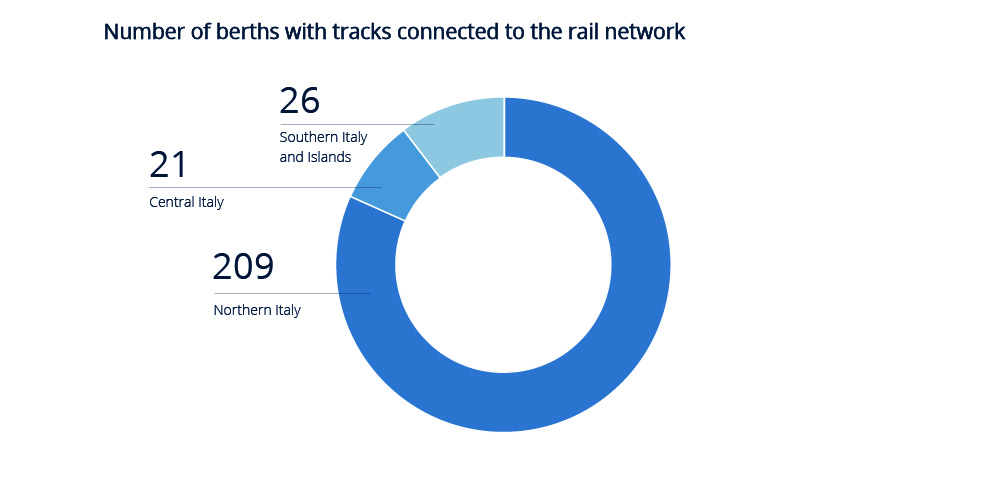
Rail-port connections are a crucial component of this transformation. According to Conto Nazionale delle Infrastrutture e dei Trasporti (CNIT) (National Infrastructure and Transport Account), in 2024, there were 256 berths with tracks permanently connected to the national rail network, compared to 216 in 2023: over 10% of the total. Growth is positive, but the provision remains unevenly distributed across the territory.

Freight trains in Italian ports: the main hubs
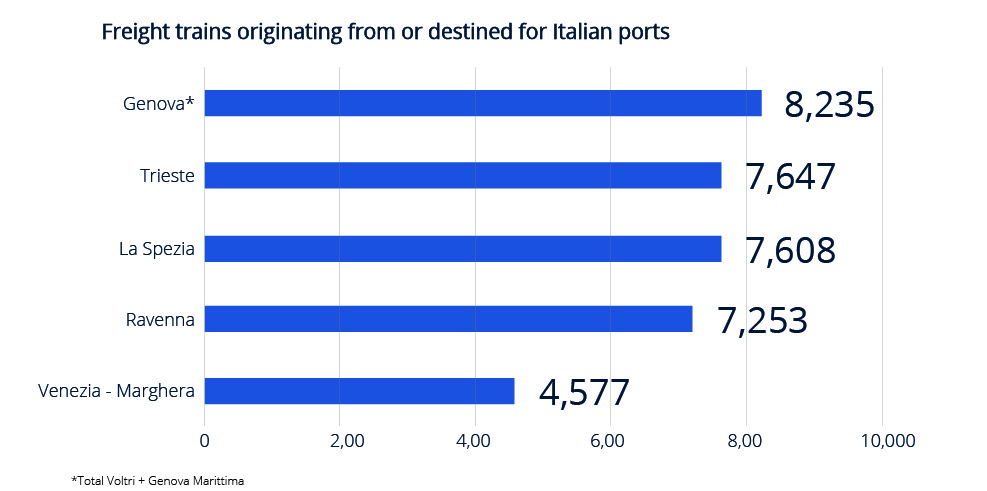
On the services side, Fermerci (an association of intermodal and rail operators) recorded approximately 45,288 freight trains originating from or destined for Italian ports in 2024. The main ports by number of trains are Genoa (8,235), Trieste (7,647), La Spezia (7,608), Ravenna (7,253) and Venice-Marghera (4,577). These figures demonstrate the importance of rail for various port systems and, at the same time, the potential for further integration.
Rail ratio and the last mile connection
Differences also emerge from the rail ratio, i.e. the proportion of containers entering or leaving the port that use rail. Trieste reaches 51%, followed by La Spezia (27.8%), Livorno (19%), Gioia Tauro (18.6%) and the Genoa-Savona-Vado system (13.2%). Investing in terminals, rail accesses and the last mile can help overcome these differences and make connections with the hinterland more competitive.
A comparison with European ports
The European comparison confirms that there is room for development: Bremen has a rail ratio of 53.3% and Hamburg 50.2%. The challenge for Italian ports is not only to increase their infrastructure but also to transform it into the capacity to offer regular, accessible rail services coordinated with the needs of stevedores.
RAIL FREIGHT TRANSPORT: OPERATORS’ INVESTMENTS AND SERVICE QUALITY
The growth of intermodality also depends on the investment capacity of both large and small railway operators. Alongside public infrastructure, companies in the sector must be able to invest in locomotives and wagons, digital technologies, safety, service organisation and skills. For smaller operators, access to financial resources and sustainable operating conditions can be particularly important in seizing new market opportunities.
A more efficient network therefore requires coordinated investment: ports and terminals must make connections and capacity available, while rail operators must be able to develop competitive, continuous and flexible services. It is this combination that can make intermodality an attractive choice for companies and encourage the shift of traffic from road to rail.
COMPANIES AND INTERMODAL TRANSPORT : WHAT LIMITS ITS UPTAKE
For the intermodal share to grow, it is not enough for the offer to be available: it must meet the needs of manufacturing companies in terms of price, time, flexibility and reliability. The relationship between ports and production sites is a privileged vantage point for understanding the factors that encourage or hinder the transfer of freight from road to rail.
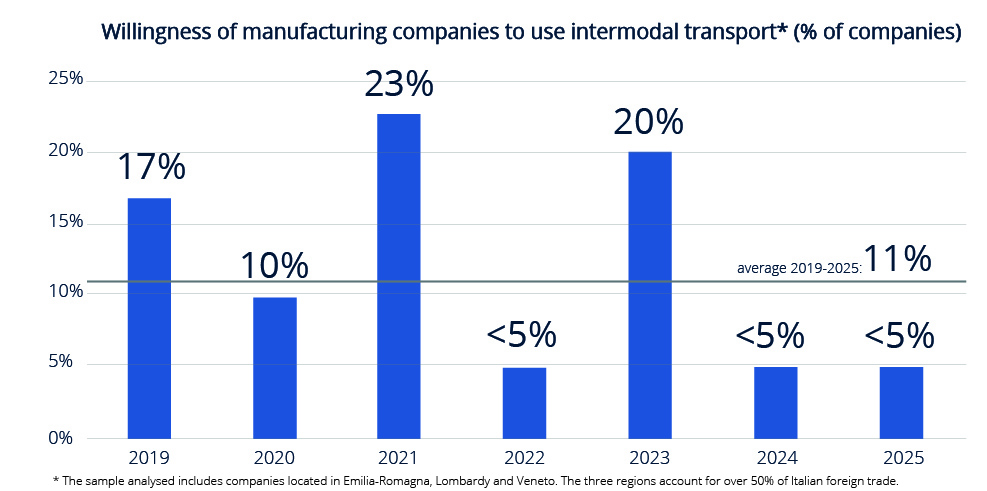
A survey entitled “Corridors and logistical efficiency of territories”, conducted by Contship and SRM (2026) among 400 manufacturing companies in Emilia-Romagna, Lombardy and Veneto, indicates that between 2019 and 2025, on average, 11% of companies used road-rail intermodal transport for connections between ports and companies. The majority continued to rely exclusively on road transport: a figure that measures the gap between the potential of intermodality and its actual uptake.
Why companies still choose road transport
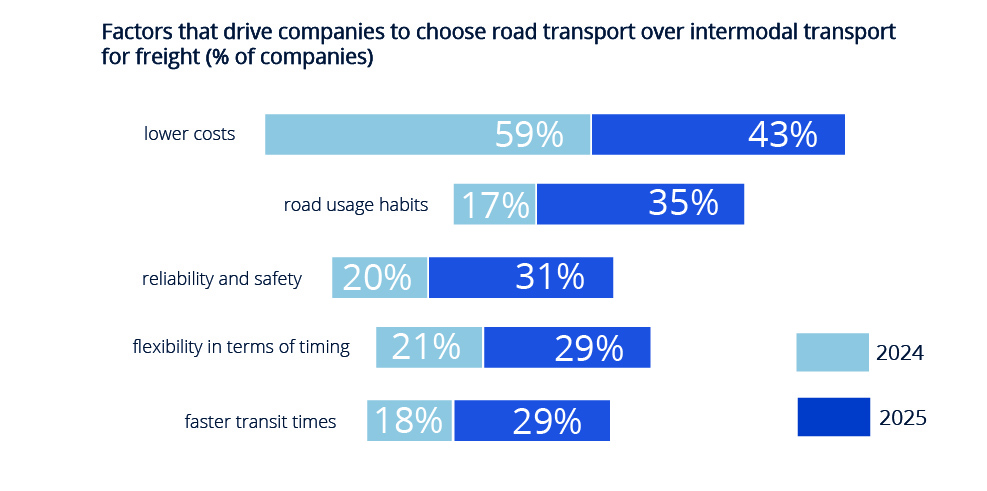
Among the reasons for preferring road transport, 43% of companies cite lower costs, compared to 59% in 2024. However, the importance of other factors is growing: 35% cite established operating practices (17% in 2024), while 31% mention reliability and security (20% in 2024). The choice of transport therefore depends not only on price, but also on the perceived quality of the service and the ease with which it can be integrated into company processes.
Signs of growing openness to intermodal transport
However, there are signs of openness. Over the next two years, 17% of companies plan to increase their use of intermodal transport, and a further 4% are considering this option: a total of 21% of the sample. To turn this willingness into actual traffic, reliable services, an economically competitive offer and better integration between operators, terminals and infrastructure are needed.
INVESTING IN INTERMODALITY TO STRENGTHEN COMPETITIVENESS OF LOGISTICS IN ITALY
Sea-rail intermodality can strengthen the competitiveness of the Italian logistics and industrial system, while also contributing to the sustainability of supply chains. The data show ports that are already highly integrated with the rail network, but also significant differences and ample room for growth. The priority is to match infrastructure with demand: more efficient rail accesses and terminals, frequent and reliable services, interoperable digital processes and solutions tailored to the needs of companies.
Investments by the entire supply chain, including those by large and small rail operators, are crucial in this process. The goal is not to increase rail traffic in the abstract, but to offer companies a practical and competitive alternative for connecting ports, production sites and markets.
F.A.Q.
F.A.Q.